Our Yeshua (Immanuel)
A collection of our studies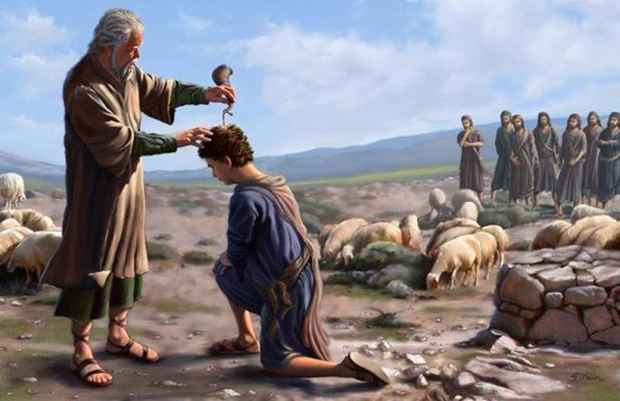

Home >> Torah >> The Anointed One - המשיח
The Anointed One - המשיח
13 Cheshvan 5784 | October 28, 2023
In English it reads “The Anointed”, in Hebrew it reads “HaMashiakh”.
This Hebrew word is formed by the article “ha [ה]” and the noun “Mashiakh [משיח]” and it occurs four times in the TaNaKH [OT]. All four of them in the book Leviticus [Vayikra]. Three in chapter four of this book and one in chapter six.
Leviticus [Vayikra] 4:3, 5, 16: ha-cohen ha-ma-shi-akh הַכֹהֵן הַמָּשׁיחַ
Leviticus [Vayikra] 6:15 (or 22): Ve-ha-cohen ha-ma-shi-akh וְהַכֹהֵן הַמָּשׁיהַ
In the mentioned Bible verses of the book Vayikra – which means “and he called” – “HaMashiakh (The Anointed One)” revers to HaCohen: The Priest.
In Exodus [Shemot] 28:36-38; Leviticus [Vayikra] 6:18-19 (or 6:25-26) and in 10:16-18 we can read what it is the priest had to do.
Every person living in Israel, Israelites and non-Israelites living within the border of Israel, was (and still is) responsible for his and her own actions. This means that it will not be accepted when you send another person to stand responsible for the sins you committed. You did the deeds; you do the time!
You need to show remorse, and, in those days, you needed to go to the Tent of Meeting [Tabernacle = Ohel Mo'ed or to the Temple [Mishcan] with your offer. You had to transfer your sins to the offer by placing your hands on/above the offer. Then the priest [ha-cohen], the anointed one [ha-mashiakh], had to take the offer from you and slaughter it. He had to do this before Adonai (Great/Exalted Lord) יהוה, our God to make atonement for you. The anointed priest took partially your sins to him, by eating some of your sin offering. This is what you had to do. Another wasn’t responsible for the mistakes you made!
Another thing that wasn’t (and still isn’t) accepted, was to crush and chastising yourself in order to gain salvation for yourselves before the face of our Lord God [Adonai יהוה]. The same goes for the entire people that wanted to make atonement before Adonai יהוה for themselves! So, we can not say that the servant from the Book Isaiah [Yeshayahu] chapter 53, the one addressed to as “he” and “him”, would be the people of Israel. Or, to say it differently, those “he” and “him” is in fact “we” and “us”.
Could it be that our father Jacob [Ya’akov] is the one, he whom our God called “My servant” and renamed him “Israel”?
I do not believe it will be tough for us to come to an agreement that no person or an entire people can make atonement for themselves!Only the priest, the anointed one, could do that. However, he too could not do that by chastising himself, but by offering a bull! Because, if a priest sinned, then the entire people had sinned automatically with him. Read Leviticus/Vayikra 4:3.
Would it be possible for a person willing to give his life to gain atonement for another person, or for an entire people? Moses [Moshe] was willing to give his life to Adonai יהוה in order to save his people. This wasn’t, however, accepted by our God. Moses could not take the sins of his people upon him. He wasn’t the anointed one. Moses wasn’t anointed to be priest nor to be king. He wasn’t even anointed to be a prophet. Yet, he was one.
Neither could an anointed king to take the sins of his people upon him, although he was responsible for and over his people. Like a father has responsibilities over his house. And the anointed prophet could not take the sins of his people upon him. Only the anointed priest [ha-mashiakh ha-cohen] could do that.
Israel, our father [Yisra’el avinu] wasn’t anointed. So, he could not be the servant of God mentioned in Isaiah 53.
Now we’ve ruled the king, the prophet and even the patriarch Jacob (Israel) out to be the mentioned servant in Isaiah 53, some of us will search for this servant among the Levites [Levi’im]. Not at all important, because it is to this ‘Israel’ – as he was addressed to a few chapters earlier of the Book Isaiah – the entire house of Jacob will be gathered and be together again.
There are offsprings from the priests of the tribe of Levi’im. However, they are not priests. They can become priests when they will be anointed as priests. But that will not happen until the Third Tempel is build. And ques who will build the Tempel?
The Anointed King [Melekh Ha-Mashiakh] – Son of David [Ben-David] – will be the One saving His people by making atonement for them by giving His Life as only He can, because He Is also the Anointed Priest in the order of Malki-Tsedek (Righteous King). This Anointed One will also be the One building the Tempel. He will be the Licht of the Nations [Ohr Goyim]. Kings of the earth will stand up (from their thrones) and bouw down and worship Him (Isaiah 49:1-7).
The idea of two Messiahs is within Judaism not completely off. Willing to search for the anointed priest among the Levites and accepting the coming anointed king from the house of David – and, therefore, from the tribe of Juda – might not be seen as a huge leap of faith. However, according to the tradition, one of the anointed ones will not be from the tribe of Levi, but from Ephraim. And let it be so that the tribe of Ephraim too is send away by our God with a certificate of divorce and is declared “not My people [Lo-Ammi]” (Jeremiah 3:8; Hosea 1:6-9; 2 Kings 18:9-12). And it is this Ephraim – which is a collective name for all the tribes from the northern kingdom – who has to be gained back. And so, that Deuteronomy [D’varim] 24 will be honored.
Although in those days kings, priests and prophets were anointed, the expected Messiah is from the tribe of Juda and from the house of David. There can not be The Anointed One from the tribe of Juda and from another tribe. Because every knee will bow down to The Messiah. Should The Messiah, the Son of David, therefore bow down to The Messiah the High Priest? Unlikely!
As mentioned before, The Messiah – who will be The Anointed King and The Anointed Priest – is from the order of Malki-Tsedek. This order too is under command of Adonai יהוה. David wrote about it in his Mizmor: Psalms [Tehillim] 110.
In verse 5 of Psalms, it says that the one sitting at the right arm of יהוה – and who is named “adoni” [my lord] by king David – will be named “Cohen l’olam al divrati Malki-Tsedek”: “Priest till eternity in the order of Malki-Tsedek”Now, this Anointed One is the one who can be King, Priest and Prophet at the same time. So, it is He who the prophet Isaiah was talking about in chapter 53. After all: Malki-Tsedek means “Righteous King”!